EAG Newsletter
Join / Renew | Membership benefits | Member login
Contact Facebook Twitter YouTube
European Association of Geochemistry EAG Blog EAG Comic

Goldschmidt2018

Perspectives Letters

Perspectives

Partners

October 2016

Goldschmidt conferences

2 weeks left to propose a session or workshop

2 weeks left to propose a session or workshop

In preparation of Goldschmidt2017, the whole geochemistry community is invited to submit suggestions for sessions before 1 November. Please note that any suggested sessions must be broad enough to attract at least 25 abstract submissions.

If you are interested in organising a pre-conference workshop or Town Hall meeting, you are also invited to submit a proposal before 1 November. Find out more.

New lecture honoring Robert Berner

New lecture honoring Robert Berner

Students and friends of the late Bob Berner are working to establish an annual lecture at the Goldschmidt Conference to commemorate his intellectual legacy in geochemistry. The lecture will be on a 'Berner' subject, which includes a wide range of topics associated with elemental cycling at the Earth's surface (molecular to planetary scale, modern to ancient oceanic and terrestrial systems, evolution of the biosphere, etc). Contributions will go directly to supporting the lecturer's travel to Goldschmidt every year.
Nominations for the first lecturer are currently sollicited and should be submitted before 15 November.

Read more, donate, nominate

Announcing sites for Goldschmidt2018 and Goldschmidt2019

Announcing sites for Goldschmidt2018 and Goldschmidt2019

After Paris in 2017, the Goldschmidt2018 will take place in Boston (USA), 12-17 August 2018, and Goldschmidt2019 in Barcelona (Spain), 18-23 August 2019. So mark your calendar!

The Goldschmidt conference is organised by the European Association of Geochemistry on odd-numbered years and by the Geochemical Society on even-numbered years.

Society News

Call for award nominations: deadlines coming up

Call for award nominations: deadlines coming up

Recognition of scientific excellence at all stages of one's career is crucial. Should you know of deserving colleagues, nominate them for an EAG Award or GS/EAG Fellowship.

What does it change to receive an award? Read testimonies from recent medallists.


bulletGS-EAG Geochemical Fellowship: recognizes scientists who have made major contributions to the field of geochemistry. Nominations deadline: 31 October.

bulletUrey Award: recognizes scientific excellence over a career. Nominations deadline: 15 November.

bulletScience Innovation Award (named after Heinz Lowenstam for his work in biogeochemistry): recognizes scientists within 30 years from the start of PhD. Nominations deadline: 15 December.

bulletHoutermans Award: recognizes scientists within 12 years from the start of PhD. Nominations deadline: 15 November.

Early Career Scientists: we need your feedback!

Early Career Scientists: we need your feedback!

ECS

The European Association of Geochemistry is constantly developing their programs and resources to support early career scientists. If you have any suggestions for further improvements or ideas that we could implement in the future, please do not hesitate to contact Steffi Lutz, our EAG Early Career Councillor, who is the voice of early career scientists within the EAG Council.

EAG Members: please vote at the Council Elections

EAG Members: please vote at the Council Elections

The Council Elections 2017 are now open and EAG members are asked to select 3 candidates out of 6. Councillors participate in council discussions, decisions, initiatives and act as ambassadors of the society. They are therefore crucial for determining the strategy and the future of the EAG.
Earlier this month, EAG members received a personalised link to vote. If you haven't received yours, please contact the EAG Office.

2016 Distinguished Lecture Program starting this Friday

2016 Distinguished Lecture Program starting this Friday

ECS

For the 6th year now, we are excited to support institutions in Eastern and Central Europe through the Distinguished Lecture Program. Prof. Alexandre Anesio, 2016 Distinguished Lecturer, will present lectures on biogeochemistry, starting his tour in Ukraine on Friday, then Romania, Slovenia and Poland next week.
If you are located in one of these institutions (or a nearby one), you are invited to attend as the lectures are open to all.

New Elements issue: Studying the Earth with LA-ICP-MS

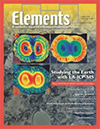
New Elements issue: Studying the Earth with LA-ICP-MS

Laser ablation inductively coupled plasma mass spectrometry (LA–ICP–MS) is a micro-analytical technique that has allowed significant research advances in many areas of the Earth sciences. The method produces quantitative elemental and isotopic analyses on the micrometer scale of most solid, and some liquid, materials across most of the periodic table. Read more

EAG members will receive their print copy shortly and have online access to all back issues of Elements (user id = email address, password = EAG membership number). To find your membership number, login to your member area.

EAG Publications

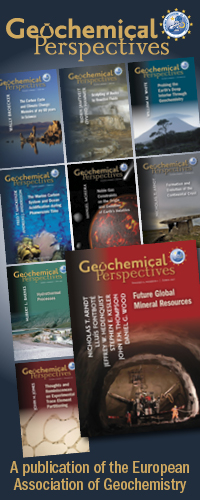
New <em>Geochemical Perspectives</em> issue now available

New Geochemical Perspectives issue now available

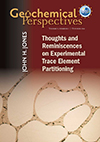
In Thoughts and Reminiscences on Experimental Trace Element Partitioning, John H. Jones (NASA Johnson Space Center) reviews the history of experimental trace element partitioning from his personal point of view. In so doing, John considers experimental and analytical complexities, simple phase equilibria, and thermodynamic considerations. John also recounts personal interactions with other geochemists and petrologists.
This article is open access and EAG members will receive the print version shortly.
Recently published in <em>Geochemical Perspectives Letters</em>

Recently published in Geochemical Perspectives Letters

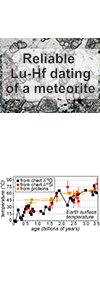
The 176Lu-176Hf systematics of ALM-A: A sample of the recent Almahata Sitta meteorite fall
R. Bast, E.E. Scherer, A. Bischoff

The application of Lu-Hf chronometry to meteorites has been compromised by arbitrary results such as dates up to 300 Myr older than the Pb-Pb age of the Solar System, unsubstantiated isochron scatter among different meteorite fractions, and varying initial Hf isotope ratios (176Hf/177Hfi). [...]


Warm Archean oceans reconstructed from oxygen isotope composition of early-life remnants
R. Tartèse, M. Chaussidon, A. Gurenko, F. Delarue, F. Robert

Deciphering the surface conditions on the Earth during Archean times (> 2.5 billion years ago – Ga) is crucial to constrain the conditions that promoted the development of life. The progressive shift through time of the oxygen isotopic compositions of Precambrian siliceous sediments – the so-called cherts – has been interpreted as indicating a secular decrease of seawater temperature by 50-80 °C from the early Archean to the present-day. [...]

EAG Blogosphere

 What does it change to receive an award?

What does it change to receive an award?

Award nominations are currently open and the European Association of Geochemistry is strongly encouraging the community to consider nominating deserving colleagues. We stress that recognition of excellence is highly significant to a scientist’s career but in practice, what does it really mean? To answer this question, we asked some of our recent medallists what did their award change for them. Kate Hendry, Klaus Mezger, Yemane Asmerom, Liping Qin and Tim Elliott answered. Read more

 EAG Ambassador in Cape Town

EAG Ambassador in Cape Town

[By Ahmed Ali] I am really grateful to the European Association of Geochemistry (EAG) for their support to attend the 35th International Geological Congress (IGC) 27 August – 4 September 2016, Cape Town, South Africa. The city of two oceans where the beautiful nature and enjoying the fresh winds first before going further into the black continent. Read more

Geochemistry making the news

Safe carbon levels in the atmosphere are now a thing of the past

Safe carbon levels in the atmosphere are now a thing of the past

[US News] We may have just passed a point of no return when it comes to Earth's climate. The low point of carbon dioxide in the atmosphere typically occurs around the last week of September. But this year, levels of late have failed to drop below 400 parts per million (ppm) – and it looks like they're not going to. Read more

Comet may have struck Earth just 10 my after dinosaur extinction

Comet may have struck Earth just 10 my after dinosaur extinction

[Science] Some 56 million years ago, carbon surged into Earth's atmosphere, raising temperatures by 5°C to 8°C and causing huge wildlife migrations—a scenario that might mirror the world's future, thanks to global warming. But what triggered this so-called Paleocene-Eocene thermal maximum (PETM) has remained a mystery. Read more

How Pluto got its heart of ice

How Pluto got its heart of ice

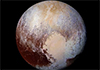
[Science] New climate simulations help explain how Pluto’s heart-shaped Sputnik Planum (lower right) got its thick glaciers of nitrogen and carbon monoxide. Some of the glaciers, first seen by the New Horizons spacecraft in July, hold ice that circulates like the material in a lava lamp. Read more

News from the primordial world

News from the primordial world

[Science Daily] A new study led by scientists at The Scripps Research Institute (TSRI) offers a twist on a popular theory for how life on Earth began about four billion years ago. Read more

Mission accomplished: Rosetta crashes into comet

Mission accomplished: Rosetta crashes into comet

[Nature News] The European Space Agency's comet-orbiting Rosetta spacecraft was successful to the last. It crash-landed on the comet 67P/Churyumov–Gerasimenko within a minute of its scheduled impact time at 11:19 UTC on 30 September, ending its 12-year long, €1.3-billion (US$1.45-billion) mission with a bump — and a final tranche of data. Read more

Job opportunities

Current job opportunities

Current job opportunities

ECS

Receive job ads as they are posted: like us on Facebook or follow us on Twitter (@EAG_). To post a position on the EAG job page (free of charge): click here.

PhD & MSc positions:

bulletPhD Position: Hydrological constraints on Rare Earth Elements dynamics in the regolith-plant continuum - Luxembourg Institute of Science and Technology

bulletPhD position in Marine Chemical Ecology / Natural products Chemistry - Alfred Wegener Institute Bremerhaven

bullet2 PhD Positions in Hydrogeology and Hydrogeochemistry - University of Waterloo and Qatar University

bulletPhD position: Role of pentavalent uranium in U(VI) reduction by microorganisms and by minerals - EPFL

PostDoctoral and Fellowship positions:

bulletResearch Associate in Weathering or Metal Stable Isotope Geochemistry - GFZ Potsdam

bullet2 Postdoctoral positions in soil chemistry/environmental (bio)geochemistry - ETH Zurich

bullet2 postoctoral positions in Experimental Mineralogy/Petrology/Geochemistry - GET Toulouse

bulletPostdoctoral Position in space science - Institut d'Astrophysique Spatiale Paris-Sud University

bulletResearch Fellow in Isotope Geochemistry - University of St Andrews

bullet2017 Exploration Postdoctoral Fellowship in Earth and Space Science - Arizona State University

bulletWiess Post-Doctoral Research Fellowship in Earth, atmospheric, and planetary sciences - Rice University

bulletDistinguished Postdoctoral Fellowship in Geosciences - Pennsylvania State University

Faculty, Technical and other positions:

bulletProfessor in Earth Sciences - University of St Andrews

bulletLecturer in Earth Sciences - University of St Andrews

bulletOpen Rank Faculty Position in Stable Isotope (Bio)geochemistry or Ecology - University of California Merced

bulletDirector of CEREGE - CEREGE

bulletNature Geoscience Editor (in solid Earth geochemistry or marine chemistry, based in Shanghai) - Springer Nature

bulletTenure track W2/W3 professorship in Experimental Planetology - University of Bayreuth

bulletCNRS researcher in Surface Earth Sciences - Laboratoire d'Hydrologie et de Géochimie de Strasbourg

bulletAssistant Professor of Earth and Planetary Sciences - Washington University

Conferences and short courses

Upcoming deadlines for geochemistry related events

Upcoming deadlines for geochemistry related events

bulletAGU Fall Meeting 2016: Early Registration deadline 3 Nov

bullet48th Lunar and Planetary Science Conference: abstracts deadline 10 Jan

bulletEGU General Assembly 2017: abstracts deadline 11 Jan

bullet11th International Symposium on Geochemistry of the Earth’s Surface: abstracts deadline 31 Jan

bulletConference: Magmatism of the Earth and related strategic metal deposits: abstracts deadline 31 Jan

See all upcoming conferences and workshops.
See programs, short courses and bursaries in geochemistry.

To add events to these webpages, please email the details to office@eag.eu.com.

Subscribe | Unsubscribe | Previous issues
Advertise in the EAG newsletter
Copyright © European Association of Geochemistry | Credit banner image: David Benavente, 2017 Photo Contest Winner