EAG Newsletter
Join / Renew | Membership benefits | Member login
Contact Facebook Twitter YouTube
European Association of Geochemistry EAG Blog EAG Comic

Goldschmidt2018

Perspectives Letters

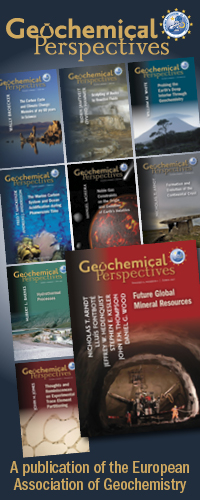
Perspectives

Partners

April 2015

Goldschmidt2015

Goldschmidt2015 preparations in full swing

Goldschmidt2015 preparations in full swing

We are pleased to report that a huge number of abstracts have been received and we are looking forward to a fantastic conference.

  • Note the deadline for Early Registration is 16 June. Members of partner societies can also benefit from reduced fees (€490 and students €295).
  • A whole series of Student Events will be proposed, as well as a Mentoring Program.
  • 12 workshops and 7 geochemical field trips are available for booking.
  • There is still time for associations and partner societies to schedule social events, meetings, ceremonies or present awards during the conference. Details here.

EAG Publications

New issue of Geochemical Perspectives coming soon

New issue of Geochemical Perspectives coming soon

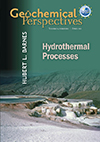
Hydrothermal Processes, the April 2015 issue of Geochemical Perspectives will feature the story of Hydrothermal Geochemistry as described through the memories of Hu Barnes, one of the great geochemists whose work has shaped our understanding of ore deposit formation. Hu’s research path spans over 7 decades and addresses discoveries related to reactions controlling the formation of many ore metal deposits, knowledge that we take today for granted. Some think ore deposit research is passé, but only through the painstaking research that Hu and his students, postdocs and collaborators have carried out was it possible to develop guidelines of how to go about looking for ore deposits and these are the norm for the explorations of crucial metals which in turn drive and sustain our society.

The issue is now in the last stages of production and the online version will be available shortly.

Two new articles in Geochemical Perspectives Letters

Two new articles in Geochemical Perspectives Letters

"Growth of upper plate lithosphere controls tempo of arc magmatism: Constraints from Al-diffusion kinetics and coupled Lu-Hf and Sm-Nd chronology" by E.J. Chin, C.-T.A. Lee, J. Blichert-Toft is now available online and "Beyond the cellulose: Oxygen isotope composition of plant lipids as a proxy for terrestrial water balance" by L.C.R. Silva et al. is in the final stages of production and an e-alert will be sent next week. Subscribe to e-Alerts.

Society News

Wouter Peters receives the EAG Eminent Speakers Award at EGU

Wouter Peters receives the EAG Eminent Speakers Award at EGU

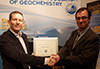
Yesterday at EGU General Assembly 2015, Wouter Peters (University of Wageningen and University of Groningen) received the EAG Eminent Speakers Award from Bernard Marty, EAG Vice-President. We also wish to thank all delegates who visited the EAG booth at EGU and particularly welcome our new members. If you are at EGU, find EAG at booth 54, Entrance Hall (we have just a few goodies left!).
April issue of Elements: Arc Magmatic Tempos

April issue of Elements: Arc Magmatic Tempos

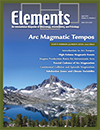
The differentiation of our planet and formation of the continental crust, and its underlying mantle lithosphere, are in large part the result of magmatic processes at convergent margins. These magmatic processes are important to issues of societal interest such as the evolution of life, mineral and energy deposits, volcanic and fault hazards, and long-term climate change. Magmatism in oceanic and continental convergent arcs is not temporally or spatially steady-state, rather it occurs in pulses and lulls. The articles in the April 2015 issue of Elements explore the tempo of magmatism as recorded in the rock record, investigate the causes of high-volume events in subduction-related magmas, and provide an overview of recently developed models to explain episodic behavior in subduction magmatism.

EAG members will receive their print copy shortly and have online access to all issues of Elements (user id = email address, password = EAG membership number). To verify your postal address or your membership number, login to your member area.

Cambridge University Press offers exclusive discount to EAG

Cambridge University Press offers exclusive discount to EAG

We are happy to inform you that Cambridge University Press offers a 20% exclusive discount to EAG on geochemistry related books, valid until 16 June. Find out more.
EAG Press Release

Bacteria can use magnetic particles to create a ‘natural batte

Bacteria can use magnetic particles to create a ‘natural batte

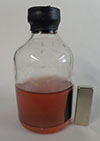
[European Association of Geochemistry] New research shows bacteria can use tiny magnetic particles to effectively create a ‘natural battery.’ According to work published in journal Science on 27 March, the bacteria can load electrons onto and discharge electrons from microscopic particles of magnetite. Read more

EAG Blogosphere

 Svalbard – The northernmost everything

Svalbard – The northernmost everything

[By Stefanie Lutz] Here in Svalbard one can find the northernmost everything: climbing wall, post office, piano… and most importantly university – the reason I came up here. Longyearbyen, the ‘capital’ of Svalbard and 79°N, hosts the University Centre in Svalbard (UNIS) – the northernmost university which offers a wide range of courses in Arctic Geology, Arctic Biology, Arctic Geophysics and Arctic Technology. As a third year PhD student in glacial biogeochemistry... Read more

Two EAG Ambassadors at AGU Fall Meeting 2014

Two EAG Ambassadors at AGU Fall Meeting 2014

A few months ago, the EAG initiated the Early Career Science Ambassador Program, supporting Early Career Scientists based in Europe to attend conferences outside of Europe. Supported scientists have 50% of their expenses covered by EAG, up to 2000 Euros, and are viewed as EAG Ambassadors while attending the event. Ruifang Xie and Hans Christian Steen-Larsen were the first two EAG Ambassadors. Read more

Geochemistry making the news

Bardarbunga eruption gases estimated

Bardarbunga eruption gases estimated

[BBC News] A massive dyke drove across the landscape, starting in August last year, producing huge fountains of lava. But the six-month event also released 11 million tonnes of sulphur dioxide that spread over the country and the Atlantic Ocean towards Europe. Read more

Carbon's importance to ocean life's survival 252 Myr ago

Carbon's importance to ocean life's survival 252 Myr ago

[Science Daily] A new study led by scientists with The University of Texas at Arlington demonstrates for the first time how elemental carbon became an important construction material of some forms of ocean life after one of the greatest mass extinctions in the history of Earth more than 252 million years ago. Read more

Wanted: staff-scientist positions for postdocs

Wanted: staff-scientist positions for postdocs

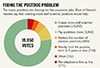
[Nature News] What is the solution to science’s broken postdoctoral system? According to a poll answered by 20,000 Nature readers, the answer is clear: postdocs need permanent, better-paid staff-scientist positions. But investigators who have already tried offering the jobs say that the change would mean downsizing their laboratories. Read more

Volcanic lightning storms are creating perfect crystal balls

Volcanic lightning storms are creating perfect crystal balls

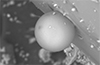
[Science Alert] Scientists have discovered tiny, perfectly round spheres of glass in the ash left over from volcanic explosions, and say they could be the key to understanding how and why lightning forms in these crazy-volatile events. Read more

Memory restored, Opportunity rover completes marathon on Mars

Memory restored, Opportunity rover completes marathon on Mars

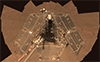
[AstronomyNow] NASA’s Opportunity rover trekking across Mars completed a marathon’s worth of driving Tuesday, extending its record-setting exploration of the red planet as engineers installed a software fix to overcome a problem with the aging robot’s flash memory. Read more

Violent collisions during Earth’s formation led to metal rains

Violent collisions during Earth’s formation led to metal rains

[Science Alert] Earth is believed to have formed about 4.6 billion years ago, growing in size as a result of frequent collisions with asteroids. These collisions are thought to have initially happened at slow speeds, and became progressively faster as the planet grew in size. Read more

Comic Relief

A humorous look at the world of science

A humorous look at the world of science

Check our latest cartoon, created by geochemists for geochemists in need of comic relief... You will also find this cartoon in the Elements April 2015 issue.

Job opportunities

Check the latest job opportunities

Check the latest job opportunities

Receive job ads as they are posted: like us on Facebook or follow us on Twitter (@EAG_). Post a position on the EAG job page (free of charge): send the details to EAG Office.

  • Misasa International Student Internship Program in Geochemistry/Cosmochemistry - Okayama University at Misasa
  • PhD Position in Ecohydrology Research Group - University of Waterloo
  • PhD position in deep subsurface microbiology - EPFL
  • Postdoctoral Position in Isotope Geochemistry ‘Isotope fractionation during fluid-rock interactions: application to terrestrial and extraterrestrial weathering’ - Observatoire Midi-Pyrénées
  • Postdoctoral Research Assistant - University of York
  • 2 year post doc position in the framework of the Marie Curie project: CO2 react - Lafarge
  • Postdoctoral fellow – Organic Geochemistry - University Pierre and Marie Curie
  • Professional Research Assistant – Lab Manager for CU Boulder Earth Systems Stable Isotope Laboratory - University of Colorado Boulder
  • Faculty Position in Coastal Physical Oceanography - University of Concepción
  • Tenure-track Assistant Professor in Environmental Geochemistry - University of Copenhagen
  • Research Scientist – Isotope Geochemistry - Washington State Uni. and University of Idaho
  • Senior Research Scientist position - Czech Geological Survey

Conferences

Upcoming deadlines for other geochemistry related conferences

Upcoming deadlines for other geochemistry related conferences

  • Geoanalysis Leoben 2015: Abstract deadline 17 April
  • AGU Fall Meeting 2015: Session Proposal deadline 22 April
  • Nutrient Cycling on the Modern and Ancient Earth conference (Co-sponsored by the European Association of Geochemistry): Abstract deadline 24 April
  • 21st European Conference on Organometallic Chemistry: Early Registration deadline 30 April
  • 15th European Conference on Solid State Chemistry: Abstract deadline 30 April
  • 15th EuCheMS International Conference on Chemistry and the Environment: Abstract deadline 30 April
  • 22nd biennial International ISEB Symposium on environmental biogeochemistry: Abstract deadline 1 May

See all upcoming conferences.

We thank you for your attention

Subscribe | Unsubscribe | Previous issues
Advertise in the EAG newsletter
Copyright © European Association of Geochemistry | Credit banner image: David Benavente, 2017 Photo Contest Winner